Yáñez
Ofrenda a la tormentaYáñez is an elderly man living amid a house preserved in the wake of family loss. His guarded responses to Amaia Salazar give way to a painful admission: he had a daughter who died hours after birth, though he initially denies that she ever existed. Amaia interprets that death through the suspected sacrificial practices of a secret group and suggests that his son carried on what his father had begun. Yáñez’s grief is visible, but the full history of his family and his part in it remains unresolved.
Identity and Introduction
A young social-services worker, Mikel, arrives with food and calls through the doorway to identify himself. Yáñez opens the door before the worker has finished speaking. His face is described as gaunt and ashen; his first response is irritated, insisting that he is neither senile nor deaf and asking why Mikel is shouting. The exchange establishes a man quick to take offense at being treated as incapable, even as the delivery of food places him in a relationship of practical dependence on outside help.
Amaia encounters him in his home while investigating his son. The interior is cold and closely furnished with the accumulated remnants of ordinary life. A bundle of football cards has been bound with an elastic band so old and dry that it has fused to their faded cardboard. Beyond the room are a small washroom and a well-stocked woodshed, where Yáñez keeps agricultural tools and open crates of potatoes and onions. A gas boiler by the exterior door is switched off. These specific details suggest a household still provisioned for daily tasks, yet marked by neglect and a chill that the available fuel and equipment do not dispel.
The House and His Grief
Amaia positions a chair between Yáñez and the television and asks about his son. He switches off the television and watches her in silence. His expression, caught between fury and bitterness, makes her regard him as unpredictable from the first time she sees him. The act of turning the set off is also a deliberate response: for the moment, he gives her his attention, but without softening his defensive presence.
When Amaia assumes that he has kept the house as it is for his son, Yáñez corrects her. He says he maintains it for his wife, and that everything remains as it was when she left. His face contracts with pain and revulsion; then tears run down his cheeks. He says it is the only thing he has been able to do, adding that he has done everything else wrong. His words make the preserved rooms more than a setting: they are the one form of action he believes remains available to him, a way of holding on to the household as it was before his wife’s departure.
Yáñez’s gaze moves from one faded ornament to another, as if an answer might be hidden among them. He covers his face with a blanket, holds it there briefly, then pulls it away with anger, as though rebuking himself for having shown weakness. Just as Amaia believes the conversation has ended, he lifts the pillow beneath his head and takes out a framed photograph. He looks at it with absorption before offering it to her. The image’s contents are not specified, but the gesture recalls another bereaved father: the father of Anne Arbizu had kept his murdered daughter’s portrait beneath a similar cushion and handed it to Amaia. The parallel connects Yáñez’s private grief to the investigation’s repeated encounters with parents and the traces they preserve.
The Daughter He Denied
On a later visit, Amaia asks Yáñez to examine a photograph of Jonan Etxaide. She reminds him that he had previously told her a police officer came to see him and that he prepared coffee with milk for the visitor. Yáñez confirms the earlier visit. The detail matters because Jonan had questioned him before Amaia, and his quiet hospitality contrasts with the hostility Yáñez displays when Amaia presses him directly.
Amaia proposes that Yáñez’s wife had been unwell before their son was born and that the birth devastated her: in Amaia’s account, she could not love the boy because he had come to replace a daughter she had lost. Yáñez first says that he never had a daughter. After Amaia insists that Jonan suspected otherwise, Yáñez falls silent. Asked the child’s name, he says she had none and was never baptized; she died of cradle death a few hours after birth. The progression from denial to this spare disclosure changes the meaning of his earlier insistence that the house was kept for his wife. It also gives substance to Amaia’s suspicion that the family’s history contained a loss concealed behind silence.
Amaia reacts with disgust and accuses him of killing his own daughter. The text does not independently establish that accusation as fact. Instead, Yáñez looks at her, begins to smile, and breaks into laughter that becomes a full, apparently uncontrolled guffaw before stopping abruptly. The abrupt change does not resolve whether he is confessing, resisting her interpretation, or responding in some other way; it leaves the exchange disturbing precisely because his reaction supplies no clear explanation.
The Son and the Secret Group
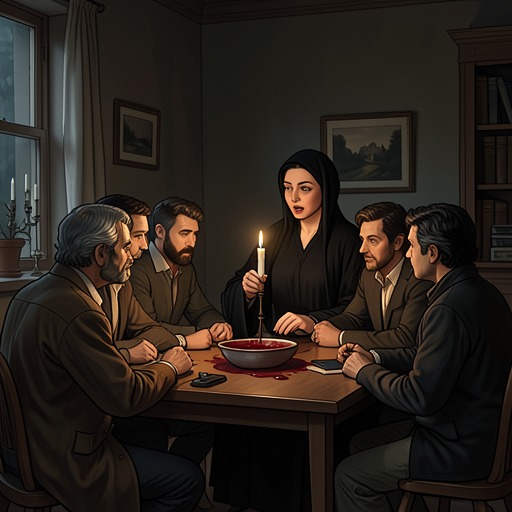
Amaia recalls the testimony of a witness hidden in an Opus Dei house: the group’s members do not leave. Applying that warning to Yáñez, she suggests that he may have left but that his son took his place, and that a sacrifice of this kind could not simply be wasted. This is Amaia’s interpretation of the family’s connection to the group, not a complete account confirmed by Yáñez in the scene. He answers her accusation neither with a denial nor with an explanation. He turns the television back on, re-establishing the barrier he had lowered when she asked about his son.
As Amaia walks down the hallway toward the exit, Yáñez calls after her. The scene ends before his words are given, withholding whatever he might add and leaving his role suspended between bereaved father, possible participant, and witness to his son’s actions. His story is shaped by that unresolved division: a daughter’s death first denied and then named, a wife’s absence embodied in a house left unchanged, and a son whom Amaia believes inherited a place in the group. The silence around these facts is not empty; it is the space in which her investigation must distinguish what Yáñez admits from what she suspects.